"War is not healthyfor children and other living things" goes the 60's poster.
It's true -- and yet westill fight wars. Why? Because war serves several important functions. One ofthe most important is to gain or preserve control of resources, particularlyterritory. For example, the European desire to expand in the 15th through 20thcenturies could only take place on Earth, and inevitably sparked a long seriesof wars both in and out of Europe, culminating with the vast trench-warfareslaughter of World War I. Today there is an entirely peaceful and far morepowerful alternative, space settlement. Space settlementis to territorial and resource wars as computer word processing is to the quillpen. Sure, you can write a book with a quill and ink pot, but why bother whenyou've got a PC and MS Word?
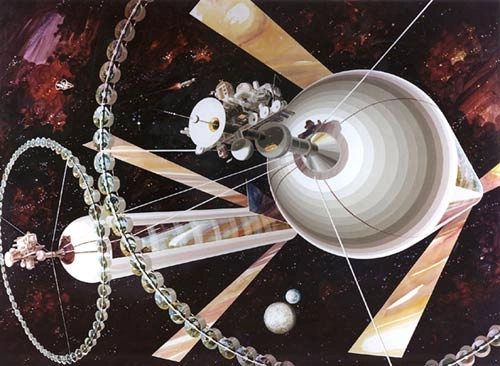
Space settlement meanspeople livingand working beyond Earth, not only on the Moon and Mars, but also in giantrotating spacecraft -- orbital space settlements.

In the 1970's Princetonphysicist Gerard O'Neill, with the help of NASA Ames Research Center andStanford University, showed that we can build giantorbiting spaceships and live in them [reference].These settlements can be wonderful places to live; about the size of aCalifornia beach town and endowed with weightless recreation, fantastic views,freedom, elbow-room in spades, great wealth and true independence. Territorialand resource wars can be made obsolete by space settlement because of onesimple fact: the vast majority of the resources available to mankind are not onEarth, they are in space. While exploiting space resources will be monumentallyexpensive, this cost is minor compared to the cost of war. A really first-classspace settlement program might cost $100 billion a year, whereas the U.S.military budget is about $600 billion. Moreover, space settlement can deliverfar, far more resources than even the most successful imaginable Earth-boundmilitary.
Consider:
- If the materials in the single largest asteroid, Ceres, were used for orbital space settlement construction, we could build territory equal to over 200 times surface area of the Earth (1). This is enough to provide every single nation as much territory as if they conquered the entire Earth. Furthermore, conquering Earth is probably impossible, whereas building space settlements is merely incredibly difficult.
- The total energy resources of this solar system are about 2.3 billion times the energy available on Earth. This is simply the Sun's energy output -- and the Sun is an enormous nuclear fusion reactor that works perfectly right now, today, and is perfectly safe -- or at least isn't going away. Furthermore, we know, more or less, how to exploit space solar power ([reference]).
- There are thousands of asteroids in orbits that cross Earth's, and just one of them, 3554 Amun, contains roughly $20 trillion dollars worth of precious metals.
Spacesettlement can make resource wars a thing of the past, something we only readabout in history books, because space settlement can deliver far, far moreresources at far, far less cost. Less money, less death, less destruction, andinfinitely less stupidity.
Resources and territory arenot the only reasons for war, but they cause a lot of them. The U.S. has spentfar more defending oil access in the Mid-East than it would cost to build spacesettlements. Perhaps it's time to change direction. Perhaps it's time to makeEarth a bit healthier for children and other living things. Perhaps it's timeto choose life over war. Perhaps it's time to start building space settlements.
Footnotes
(1) This works because mostof the mass of space settlements is in the hull, not filling three-dimensionalspace. The hull is very thin compared to a planet or large asteroid so uses farless mass for the same living area. Rotation is used to provide a feelingsimilar to gravity with far less mass.
AlGlobus serves on the National Space Society Board of Directors and is a seniorresearch associate for Human Factors Research and Technology at San Jose StateUniversity at NASA Ames Research Center.
NOTE: Theviews of this article are the author's and do not reflect the policies of theNational Space Society.
Visit SPACE.com/Ad Astra Online for morenews, views and scientific inquiry from the National Space Society.
- VIDEO:From NASA to Near-Earth Objects?
- TOP10 Reasons to Inhabit Outer Space
- IMAGES:Extreme Living: Scientists at the End of the Earth