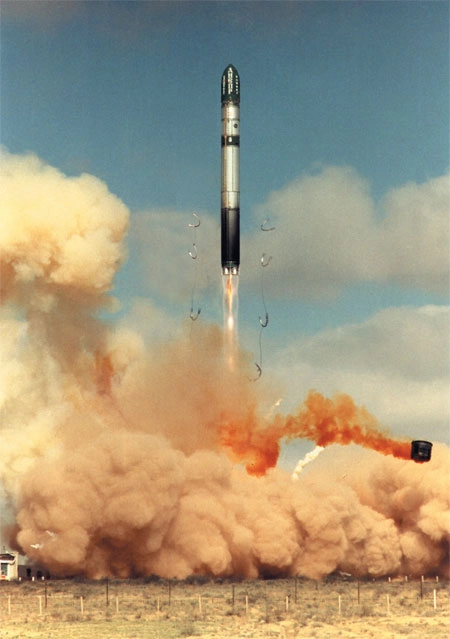
Futurelaunches of a converted ballistic missile now used to loft satellites spacewardare on hold as investigators hunt for clues to learn why the Dneprrocket crashed on the steppes of Kazakhstan last week, according to Russianwire reports.
"Roscosmos [theFederal Space Agency] has suspended launches of Dnepr carrier rockets until thecommission investigating the crash causes completes its work," Igor Panarin, aFederal Space Agency spokesperson, told Russia's Interfax News Agency. "Roscosmoshead Anatoly Perminov bound the commission to submit its conclusions by August28."
An ISCKosmotras Dnepr rocket carrying 18small satellites crashed about 15 miles (24 kilometers) south of Baikonur Cosmodromeless than two minutes after launch according to initial reports, though Interfaxreports stated Tuesday that the rocket's crash radius extended some 93 miles (150 kilometers) from its launch pad. A malfunction with one of the booster's three stages was initially cited as a potential cause of the crash.

The failurecame two weeks after a successfulDnepr launch of a U.S.-builtinflatable module designed to serve as a prototype for future mannedvehicles in orbit. Two days after the Dnepr crash, another converted missile -a Rockot booster - successfullylaunched a South Korean satellite into orbit from Russia's PlesetskCosmodrome after suffering its own failurein 2005.
The Dnepr'scrash spewed to 1,000 times the acceptable amount of toxic heptyl rocket fuel aroundan uninhabited area of Kazakhstan's Kyzylorda region, according to Interfaxand Associated Press reports.
AlexeiYablokov, an environmentalist and member of the Russian Academy of Sciences,told Interfax that cleaning up the contaminated region will be a heftyjob.
"The costof the problem is some $10 million, in my estimate," Yablokov told Interfax,adding that removing and burying the contaminated soil is among the few optionsto clean up crews. "No clearly developed or effective method for dealing withdisasters of this kind is known today."
Russia'sFederal Space Agency has pledged to compensate Kazakhstan for the environmentaldamage caused by the heptyl contamination, but local officials took heart thatno one appears to have been injured in the Dnepr crash.
"A medical examinationof residents in the villages of Zhanakala and Kuandariya revealed no healthdisorders as of July 31, 2006," Azamat Abdymomunov, who serves as Kazakhstan'sdeputy education and science minister in charge of a government commissionhandling the Dnepr failure, told Russian reporters Tuesday.
Accordingto wire reports, the largest concentrations of heptyl contamination were foundwithin 492 feet (150 meters) of the Dnepr booster's crash site.
"Thenearest village is 35 kilometers from the site of the crash," said Igor Panarin,a Federal Space Agency spokesperson, in an Interfax interview. "Watersamples tested yesterday indicate that there are no fuel components in thewater. This inspires optimism."
Despite thehold on Dnepr launches, Russian space officials said the accident will not forcean abandonment of future Dnepr or Proton rocket space shots fueled by heptylpropellant. The current investigation, however, must be complete before a Dneprbooster launches again, they added.
Crashinvestigators said that a 1999 agreement between Russian space officials andKazakhstan, home to the Baikonur Cosmodrome spaceport, clearly states that theRS-20 rockets used to develop Dnepr boosters should be tabled until an accidentinvestigation is complete.
"It saysthat 'pending efforts to establish the cause of the disaster, the use of RS-20rockets [at Baikonur] must be suspended," Abdymomunov told Interfax.
Also known as SS-18 rockets in the U.S., the Dnepr booster is a 111-foot (34-meter) tall launch vehicle with a 10-foot (three-meter) diameter and draws on three stages to reach orbit.
Theannouncement their flight suspension comes a few days before the planned Aug. 4 launch of a RussianProton M rocket to orbit the Hot Bird 8 telecommunications satellite for the Paris-basedEutelsat, but that flight is not expected to be affected.
The McLean,Virginia-based firm International Launch Services - not the jointUkraine-Russia effort of ISC Kosmotras - is managing the Proton M's mission,which is set to liftoff Friday at 5:48 p.m. EDT (2148 GMT). It will be 3:48a.m. on Aug. 5 at the Proton M's Baikonur launch pad.
"We'restill on track," ILS spokesperson Fran Slimmer told SPACE.com. "They rolledout to the pad today."
Thisreport is a combination of multiple Aug. 1 Interfax, Associated Press and SPACE.comreports.
