


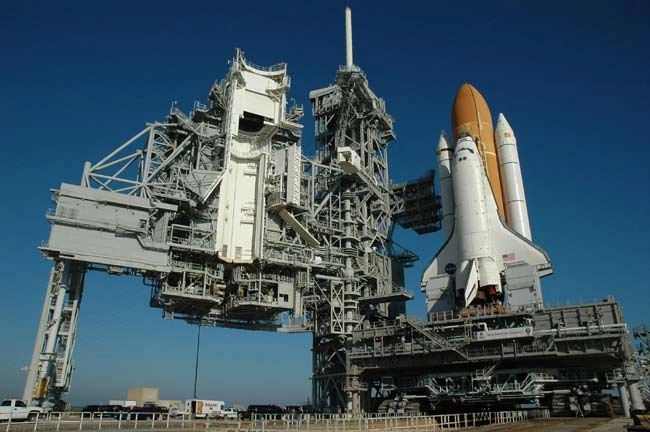
Sevenastronauts are officially set to ride NASA's Discovery orbiter towards the International SpaceStation (ISS) next week even as engineers tackle glitches with theorbital laboratory, top shuttle managers said late Wednesday.
"I think we'reready to go fly," Wayne Hale, NASA's shuttle program manager, told reportersduring a press briefing at the agency's Kennedy Space Center (KSC) in Florida. "We'reon track to getting a third flight done by the end of the year."
Discoveryis scheduled to rocket spaceward on Dec. 7 at about 9:36 p.m. EST (0236 Dec. 8GMT) to continue assemblyof the ISS. The planned space shot, which follows successful Julyand Septembermissions, will mark NASA's first night shuttle launch since the 2003 Columbia accident.
VeteranNASA shuttle flyer MarkPolansky is commanding the 12-day spaceflight, which includes the deliveryof a newportside piece of the ISS, a trio of tricky spacewalks to rewirethe outpost's electrical grid, and an astronautswap for the station's Expedition14 crew.
"One thingthat really struck me in this review is really how complex this mission is," WilliamGerstenmaier, NASA's associate administrator of space operations, toldreporters after a two-day Flight Readiness Review at KSC.
The STS-116mission's launch window currently closes on Dec. 17 since Discovery'scomputers werenot designed for missions that span the crossover from one year to thenext. But that limitation would be revisited if required, shuttle officialssaid.
"Myposition is, we'll need to revisit it on the 15th or 16th,as we get close," Hale said, adding that the mission could even slip to Januaryif deemed necessary.
ISSglitches
Whileshuttle engineers prepare Discovery for its ISS-bound flight, space stationengineers are puzzling over two glitches that arose in the last two days.
A circuitbreaker regulating power for one of two motors designed to turn a massiverotary joint that allows the station's portsidesolar arrays to track the Sun--which is scheduled to begin during STS-116--poppedopen Tuesday during a software test, Gerstenmaier said, adding that having bothsystems operation so one can serve as a backup is preferred for the upcomingspaceflight.
"If it's onthe software side, it's not a concern at all," Gerstenmaier said.
Engineersare also going over a curtailed reboost maneuver designed to push the ISS intoa higher orbit so it will be in the best position to meet Discovery when thespacecraft arrives at the outpost on Dec. 9.
The nearly 20-minuteburn using thruster aboard a Russian-built cargo ship shut down after only twominutes late Wednesday afternoon, though ISS flight controllers plan to try themaneuver again on Friday.
"That'spretty typical, if you follow the space station world," Gerstenmaier said ofthe glitch. "We planned ahead for that. On Dec. 1 we can go ahead and continuethat reboost activity."
Night launchesto resume
NASA'sfirst three shuttle flights following the Columbia accident launched indaylight to allow clear views of any foam debris shed by their external tanks.A piece of fuel tank foam pierced Columbia's heat shield during liftoff and ledto the loss of the shuttle and seven astronauts during reentry.
But after aseries of fuel tank safetychanges and two smooth liftoffs earlier this year, the time has come to resume nightlaunches, NASA officials said, adding that radar stations should pick upany significant foam shedding events.
"There werereally no dissenting opinions to a night launch," Gerstenmaier said.
Earlierthis month, NASA officials decided to put off yet another shuttle fuel tankmodification--the removal of about half the insulating foam covering a series oficefrost ramps protecting connection brackets--to allow more study and analysis.The so-called ice frost ramp redesign, an interim step to final, foam-lessmodification, was slated to fly aboard a shuttle fuel tank in March 2007.
"Unfortunately,we were not successful in getting a design that met with engineering approval,"Hale said of the interim fix, but added that engineers now have a better handle ofthe debris risk posed by ice frost ramps after studying this year's earlier shuttleflights.
NASA launchdirector Michael Leinbach said the countdown for Discovery's STS-116 liftoff isslated to begin on Dec. 3 at 11:00 p.m. EST (0400 Dec. 4 GMT).
- Mission Discovery: The ISS Rewiring Job of NASA's STS-116
- Complete Space Shuttle Mission Coverage
- The Great Space Quiz: Space Shuttle Countdown
- All About the Space Shuttle
