


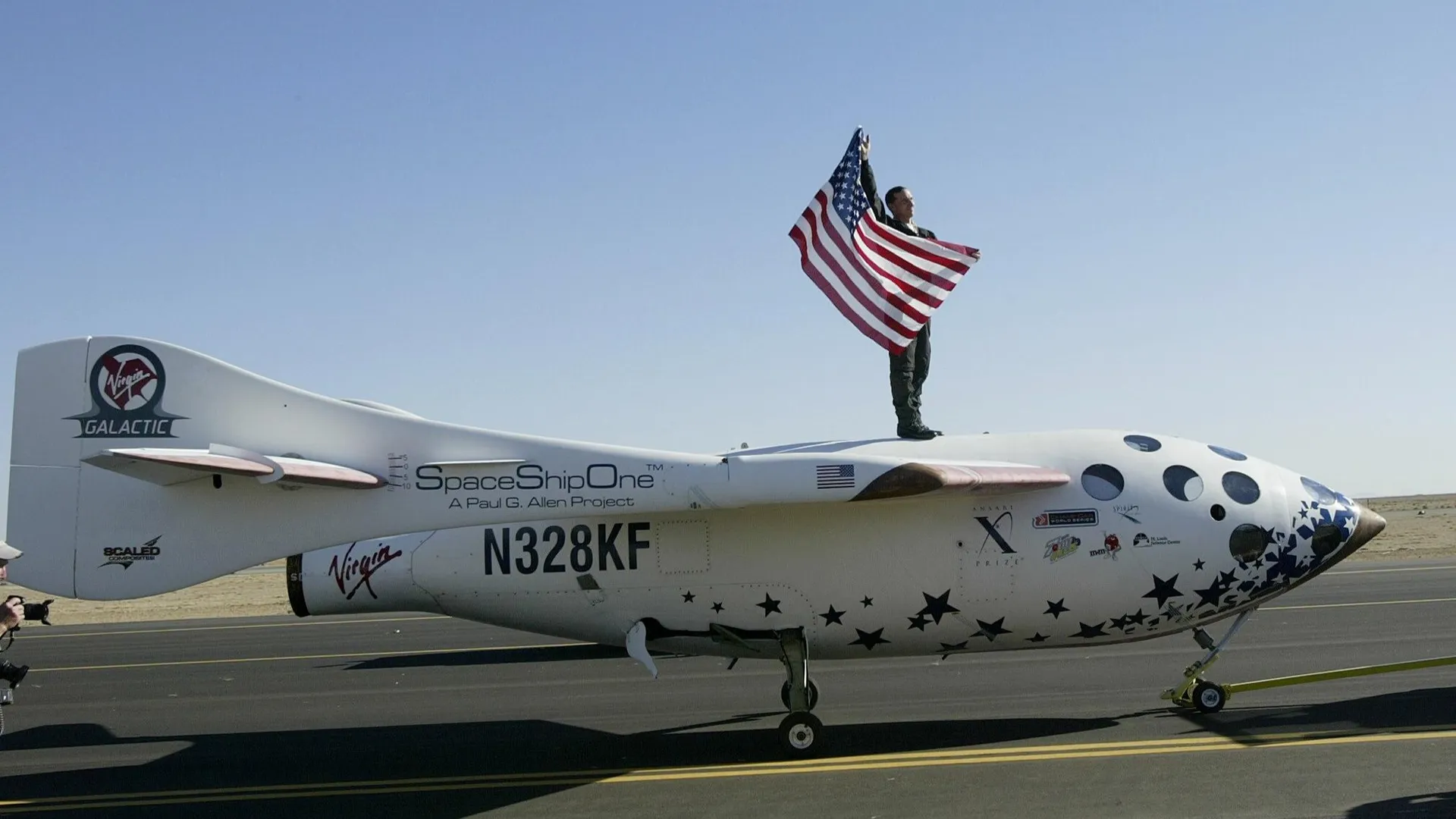
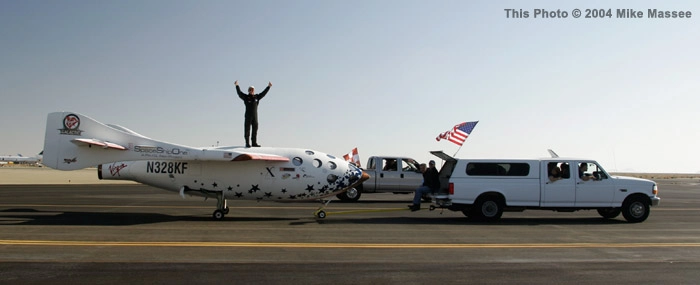
A major turning point for private spaceflight occurred on June 21, 2004, when SpaceShipOne, the first nongovernmental crewed spacecraft, flew 62.5 miles (100 kilometers) above Earth's surface. In doing so, the vessel crossed a boundary called the Kármán line, the accepted point of entry to space as defined by the International Astronautical Federation.
After two more flights in 2004, one on Sept. 29 and another on Oct. 4, the piloted vehicle won the $10 million Ansari X Prize for repeated flights in a privately developed, reusable spacecraft.
Reaching space
SpaceShipOne was a space plane designed and fabricated by Scaled Composites, a company owned by aerospace designer Burt Rutan. The ship's development was backed by the deep pockets of billionaire Microsoft co-founder Paul Allen in a joint venture named Tier One, whose objective was to develop technology for low-cost routine access to space.
SpaceShipOne was 28 feet (8.5 meters) long. The cigar-shaped fuselage was about 5 feet (1.5 m) in diameter and could carry a pilot and up to two passengers. The plane had short, wide wings with a 16-foot (5 m) span. Large, vertical tail booms were mounted on the end of each wing. During re-entry, the rear half of the wings folded upward, increasing drag while maintaining stability; then, the wings were moved back into the gliding position for landing.
The spacecraft was launched in midair, at an altitude of about 50,000 feet (15,000 m), from the underside of its mothership, White Knight, a turbofan-powered airplane. After SpaceShipOne glided for a few seconds, hybrid rocket motors on it fired for 80 seconds to loft the craft just beyond the atmosphere. SpaceShipOne arced through space for about 3 minutes and then glided back to Earth without making a complete orbit around the planet, otherwise known as a suborbital flight.
SpaceShipOne made 17 flights in all. Spaceflight was achieved on the 15th flight. Test pilot Michael Melvill was at the controls for that momentous trip, and he later became the first licensed commercial astronaut.
After the first flight into space, the ship made two more flights before being retired from active service. The ship set the following records during its last two flights:
- On Sept. 29, 2004, Melvill flew to an altitude of 64 miles (102 km).
- On Oct. 4, 2004, pilot Brian Binnie flew to an altitude of 70 miles (112 km).
Paving the way
In 2009, five years after the success of SpaceShipOne, Rutan rolled out a new version of the spaceliner, called SpaceShipTwo, and its carrier plane, WhiteKnightTwo. This venture was backed by British entrepreneur Richard Branson and his commercial spaceflight company, Virgin Galactic. SpaceShipTwo is manufactured by The Spaceship Company, a fully owned Virgin subsidiary that used to be jointly owned by Virgin and Scaled Composites. (Virgin became the sole owner in 2012.)
SpaceShipTwo was designed to fly two pilots and six passengers on short, suborbital spaceflights that travel more than 62 miles (100 km) above Earth, offer a few minutes of weightlessness and then return to a runway landing. Tickets for SpaceShipTwo flights cost $250,000 apiece.
On Dec. 13, 2018, the VSS Unity SpaceShipTwo test vehicle reached an altitude of 51.4 miles (82.7 km). That's a little higher than the boundary of space, as defined by the U.S. Air Force, but still below the Kármán line.
The VSS unity space plane flew just 32 times, including non-space test flights. It was used in 12 crewed spaceflights in total. The final flight occurred on June 8, 2024.
Virgin Galactic is now favoring its new "Delta Class" of spacecraft which is being designed to fly more often. The new Delta class of spacecraft will be able to fly at least twice a week, about eight times the rate of SpaceShipTwo, with Virgin Galactic planning to build at least two to start its new fleet, Space.com previously reported.
Additional resources
Check out photos of Virgin Galactic's test flights over the past few years. Read more about the SpaceShipOne exhibit at the Smithsonian National Air and Space Museum. Watch this video about the team that created SpaceShipOne, from the Smithsonian National Air and Space Museum.
