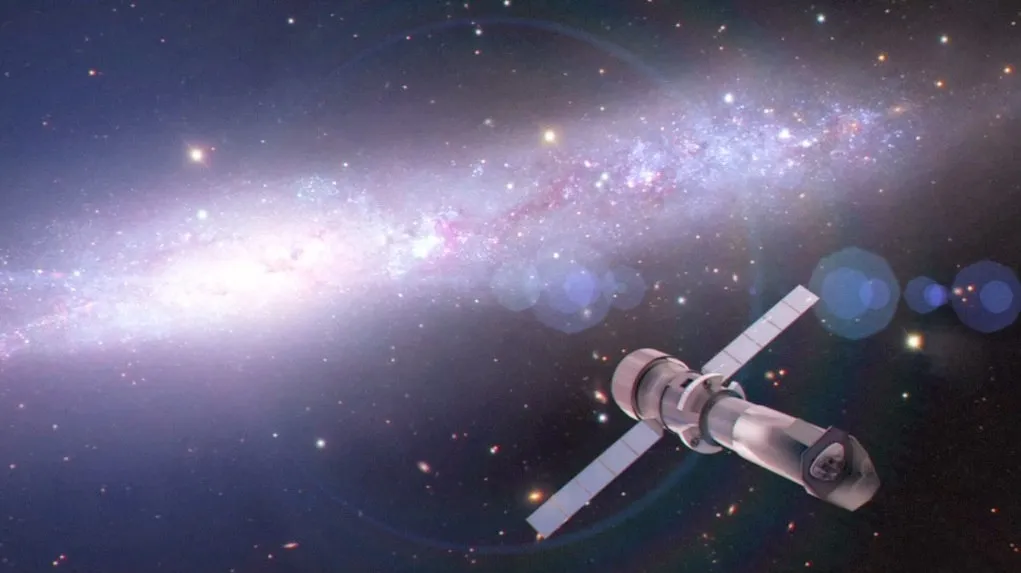
Athena, or Advanced Telescope for High-ENergy Astrophysics, is a European Space Agency (ESA) large-class mission expected to launch in 2028.
The spacecraft is an X-ray observatory expected to answer questions about the hot and energetic universe. The two main questions include "How does ordinary matter assemble into the large-scale structures that we see today" (such as galaxy groups and clusters) and "How do black holes grow and influence the environment around them." A black hole's environment is best seen in X-rays, and hot gases, which are visible in X-rays, can give clues about galactic structure formation and evolution.
Science objectives of Athena include investigating:
- how galaxy groups and clusters form and evolve;
- how hot "baryons," or subatomic particles, evolve;
- missing baryons in the intergalactic medium, or plasma between galaxies;
- how black holes and supermassive black holes grow over time;
- how black holes influence "active" galaxies (those galaxies that produce an extraordinary amount of energy);
- the effects of active galactic nuclei on galactic clusters and star formation.
The launch vehicle hasn't been determined yet, but it's possible that Athena will launch on an Ariane 5. After launch, the spacecraft will then be placed in a stable gravitational area in space known as a Lagrange point. In this case, Athena will use L2, which is on the "dark" side of the Earth (meaning that it is exactly opposite of the sun.) L2 has also been used for missions such as WMAP (the Wilkinson Microwave Anisotropy Probe) and Planck, and will be the location of the future NASA James Webb Space Telescope after launch in 2018.
Athena will perform about 300 pointed observations of celestial objects each year, ESA stated. Each observation will last an average of 105 seconds. While there will be a planned observation campaign, there will be flexibility to move Athena to a target if a transient event in the sky is noticed, such as a gamma-ray burst. Planning allows this to happen twice per month, ESA said.
Athena is expected to last five years, although consumables (such as fuel) have been rated for 10 years in the case of a mission extension.
Athena history
Athena is named after an Ancient Greek goddess who favored Odysseus, the hero of the Odyssey. The telescope project was born out of the reformulation of several older missions. At first, ESA and NASA were each pursuing different telescope projects, called XEUS and Constellation-X respectively. This changed in 2008 after officials from NASA, ESA and the Japan Aerospace Exploration Agency (JAXA) agreed on an International X-Ray Observatory (IXO) to merge the Constellation-X and XEUS projects.
The United States periodically conducts studies among space scientists to determine the priorities for the coming decade, which is called the decadal survey. ESA has its own priority list that draws from the recommendations of the Cosmic Vision Programme 2015-2025. The 2010 U.S. decadal survey ranked IXO fourth among large-scale missions. In 2011, ESA issued a statement saying the agency would go alone for large-scale missions. It cited the lack of support in the decadal survey for three joint European missions, and added that it had concerns that NASA funding would not let the missions launch in a timely fashion.
ESA subsequently moved forward with a modified version of IXO under Cosmic Vision, known as Athena. Athena was among the candidates proposed for the first large-class mission launch competition in 2012, but officials ultimately chose JUICE (the JUpiter ICy moons Explorer). Athena was instead chosen in 2014 for the second large-class mission opportunity, for a launch in 2028.
"The mission has now entered the study phase; once the mission design and costing have been completed, it will eventually be proposed for 'adoption' around 2019, before the start of the construction phase," ESA wrote in a summary page about the mission.
While Athena's design is still being determined, the telescope will likely have an X-ray telescope with a focal length (distance between the center of its lens, and the focus of the telescope) of about 12 meters, or 39 feet. It will also include two instruments: an X-ray Integral Field Unit for high-spectral resolution imaging, and a Wide Field Imager that will get more moderate resolution spectroscopy over a wide field of view.
"The telescope will use silicon pore optics (SPO), which will provide a unique combination of a large collecting area and good angular resolution across a large field of view while meeting a stringent mass budget," ESA stated on another page. Arrays of these pores will be placed into modules using commercially available silicon wafers, the agency added. These wafers will be cut, arranged and stacked in a radial pattern to focus the light.
Supporting the X-ray optics will be a mirror assembly module that will include a sun protector, a straylight baffle and a thermal baffle so that the telescope can perform its sensitive observations with a minimum of interference.
Other X-ray telescopes in space
With dozens of X-ray telescopes launched into space, it is difficult to summarize all of the missions quickly. The first of these launched in the 1970s, and observations from X-ray telescopes continue today. Some of the larger and more recent missions are summarized below.
The Chandra X-ray Observatory was launched on the STS-93 shuttle mission in July 1999, and is still operating. Chandra is considered one of NASA's "Great Observatories," referring to a program in the 1980s and 1990s that birthed the large-class observatories of the Hubble Space Telescope, Compton Gamma-Ray Observatory and Spitzer Space Telescope. Chandra has made numerous discoveries, including imaging a halo of hot gas around the Milky Way, showing that nearly all stars on the main sequence of evolution emit X-rays, and observing X-ray emission from Sagittarius A* (the supermassive black hole at the Milky Way's center).
XMM-Newton (X-ray Multi-Mirror Mission) is an ESA mission launched in December 1999 aboard an Ariane 5 rocket. XMM-Newton is a part of ESA's Horizon 2000 program, a previous long-term plan the agency followed for choosing missions. Its mission has been extended several times, and the observatory remains in good health. Its discoveries include measuring the spin rate of a supermassive black hole (along with another observatory called NuSTAR) and making observations of massive galaxy clusters, which help confirmed the presence of dark energy.
The Swift Gamma-Ray Burst Mission has instruments on board that can observe these transient phenomena using gamma-ray, X-ray, ultraviolet and optical wavelengths. It flew into orbit in 2004 aboard a Delta II rocket, and remains in operation. It has seen black holes, supernovas (star explosions), active galactic nuclei, comets and many other things. Among its discoveries was finding a new kind of gamma-ray burst that is not associated with a supernova, which was a surprise to astronomers.
ESA's INTErnational Gamma-Ray Astrophysics Laboratory (INTEGRAL), which launched in 2002 and is still operational, has a similar mission to Swift. In conjunction with NASA and the Russian Space Agency, INTEGRAL examines gamma-ray bursts. Besides gamma-ray bursts, it has performed observations of X-ray binaries as well as X-ray sources outside of the galaxy. This includes the cosmic X-ray background, the remnant of radiation left over from when the Milky Way was born.
Additional resources