Updated at 1:40 p.m. ET
"Now that was fun."
-- Pilot Mike Melvill
MOJAVE, CALIFORNIA - In a frightening mission that could nonetheless herald a new era of space tourism, a privately built, three-person rocket ship flew to space and back today.
The craft, SpaceShipOne, made an unscripted series of rolls near the top of its flight. The engine was shut down early. The flight terrified some who watched from the ground and on a live webcast.
The pilot seemed unfazed, however.
"That was a really good ride. I feel like I nailed it," said Mike Melvill after he landed. "But right up at the top I got a surprise when it really spun up and did a little victory roll."
The event was the first of two flights scheduled to capture the $10 million Ansari X Prize.
The X Prize money goes to the first privately built vehicle that can haul a pilot and two passengers to the edge of space, then repeat the feat within two weeks, in this case by Oct. 13. SpaceShipOne's design team, Scaled Composites, based here at the Mojave Spaceport, said before the flight that they were ready to turn the vehicle around for reflight, perhaps making the second rocket run Oct. 4.
Trouble at the top
Under clear desert skies here, SpaceShipOne was under the controls of a single pilot, but it was weighted as if three people were aboard.
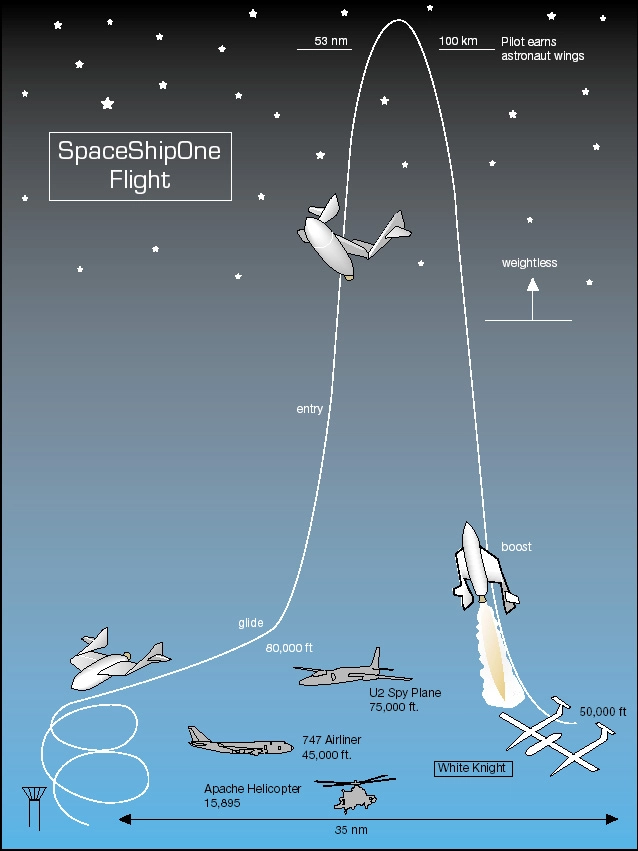
Slung underneath the White Knight carrier aircraft, SpaceShipOne and Melvill headed down the runway just after daybreak and lifted off to the cheers of thousands of gathered well-wishers. The joined vehicles made a slow spiraling ascent high above the desert landscape. The White Knight then released SpaceShipOne. After dropping and gliding a few seconds, Melvill ignited the vehicle's hybrid rocket motor.
The target was 62.5 miles (100 kilometers) altitude - a sky-high goal required by the X Prize Foundation of St. Louis, Missouri in order to vie for the cash prize. The altitude is generally considered to be the threshold of space.
The unofficial altitude reached was 358,000 feet. That's 67.8 miles (109.1 kilometers). An earlier report put the altitude at 330,000 feet.
On the way up, SpaceShipOne went into an unexpected roll, twirling at a pace of several times per minute. Melvill shut down its main engine sooner than expected.
"Uh oh, uh oh"
The spinning "does not appear to be scripted maneuver," according to the official narration of the flight released after the SpaceShipOne had landed. The craft started spinning a minute after burn started, officials said.
"Uh oh, uh oh, he is in the roll it appears at this point," the transcript reads.
It is not yet clear what the problem was, however. Melvill did indeed turn the spaceship into an airplane, as planned, and then glided down.
SpaceShipOne returned later in the morning and landed on the same runway.
"Now that was fun," Melvill said afterward. "I shut the engine down at 11 seconds before it would have shut down automatically. So we would have gone a long way higher than we really did."
Things didn't seem so glorious from below.


"My heart stopped here on the ground," said Erik Lindbergh, grandson of famous flyer Charles Lindbergh. Erik Lindbergh is on the board of the X Prize.
Could have gone higher
Melvill said the control issues were building up, leading him to shut down the engine. "I knew I had done the 100 kilometers with room to spare," he said.
"We were asking him [Melvill] to go-ahead and abort and shut it off where he wouldn't have gone a 100 kilometers," SpaceShipOne's chief designer, Burt Rutan. "He stayed in there just for a handful of seconds more."
Despite the control issues, Rutan said the ship is ready to go for the next X Prize flight.
"We will be analyzing why we got the roll near the end," Rutan said. "Will it delay whether we fly on Monday or not, I don't know that ... we have to look at the data."
If there's no needed delay, the ship can easily be turned around for a Sunday or Monday flight, Rutan said.
Space Tourism to come?
Aside from the obvious dangers in spaceflight that today's mission highlighted, the flight promises to boost hopes of putting regular folks in space. Curious onlookers and space tourism promoters were on hand for the historic flight.
The White Knight carrier plane was emblazoned with the logo of Virgin Galactic, which earlier this week announced it would contract for a variant of SpaceShipOne to carry paying tourists into space.
Robert Bigelow, billionaire hotel magnate and space tourism promoter, said this about SpaceShipOne this morning: "I'm impressed with the sheer speed of the vehicle." It goes over Mach 3 (Mach 1 is the speed of sound) and is privately built. "That's an accomplishment in itself besides all the other things it'll do today."
Bigelow this week announced a new prize of $50 million for the first private group that can build an orbiting, passenger-carrying spacecraft.
Wayne Stacy, 36, a coach and sports science professor from Simpson College in Indianola, Iowa, just came to the Mojave to watch a bit of history.
"I missed class for this, but the students did not seem to mind," Stacy said. He saw first SpaceShipOne spaceflight on television in June. "It was just amazing. I just had to be here to see what is one of the most significant events of our time." Stacy thinks the space tourism industry "is already going. But we need events like this to create awareness outside the space community."
Verification required
Whether or not the vehicle officially reached qualifying altitude will be verified by independent methods, said X Prize Foundation head Peter Diamandis in a pre-flight interview with SPACE.com.
At least three independent methods, two radar tracking systems, and an onboard "gold box" will be used to verify flight conditions and altitude, Diamandis said. There appears little doubt the threshold was exceeded.
"One down and one to go," Diamandis said after today's flight.
More than a dozen teams around the globe are building, testing, and flying hardware to compete for the Ansari X Prize, an offer that expires at year's end. The X Prize Foundation hopes to jump-start the space tourism industry through competition among entrepreneurs and rocket experts.
SPACE.com's Anthony Duignan-Cabrera and Robert Roy Britt contributed to this report.
- X Prize and SpaceShipOne: Full Coverage
Read an account of the tense moments of the flight
Related News
- New $50 Million Prize for Private Orbiting Spacecraft
- Virgin Galactic to Offer Public Space Flights
- Now Boarding: Zero-G Flights for Everyone
- The Rise of Space Tourism