


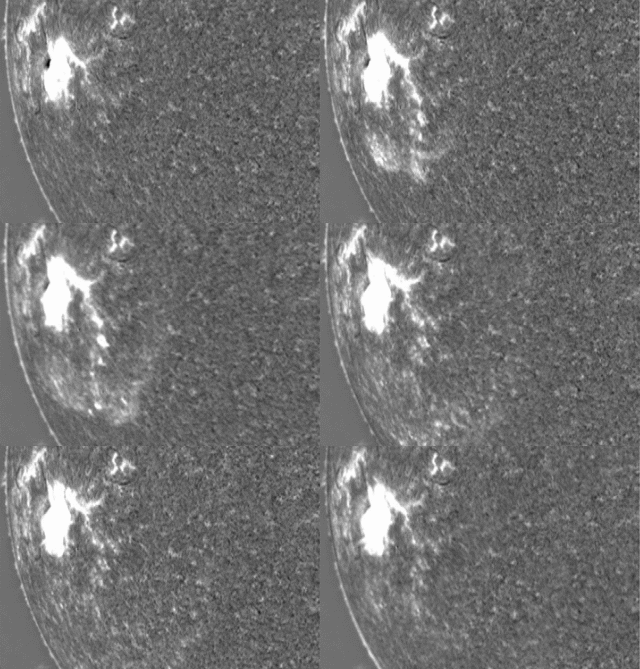
A major flare on the Sun earlier this week generated what scientists are calling a solar tsunami.
The tsunami-like shock wave, formally called a Moreton wave, rolled across the hot surface, destroying two visible filaments of cool gas on opposite sides of the visible face of the Sun.
Astronomers using a prototype of a new solar telescope in New Mexico recorded the action.
"These large scale 'blast' waves occur infrequently, however, are very powerful," said K. S. Balasubramaniam of the National Solar Observatory (NSO) in Sunspot, NM, "They quickly propagate in a matter of minutes covering the whole Sun, sweeping away filamentary material."
It is unusual to see such an event from a ground-based observatory, Balasubramaniam said. And it was also unusual that it occurred near solar minimum, when the Sun is at its least active during an 11-year cycle.
But solar activity can come at any time. Flares like this one are spawned by sunspots, which are dark, cool regions that cap magnetic activity below. When the caps pop, colossal doses of superheated matter and radiation are unleashed.
Sunspot 929 began kicking up flares Tuesday, when a major X-9 event was detected by a space-based observatory.
When another flare erupted Wednesday, the NSO's Optical Solar Patrol Network (OSPAN) was watching.
A shock wave propagated like the splash from a rock thrown into a pond. This was seen as a brightening from compressed and heated hydrogen gas. Astronomers enhanced the contrast of the images to bring out the detail, and they created an animation of the event.
Later, the shock wave swept across two dark filaments widely seprated on the solar surface, and they disappeared for a few minutes. Scientists are unsure whether the filaments were blown off or were compressed so they were temporarily invisible, according to an NSO statement.
Forecasters say there is a 40 percent chance of more major flares through this weekend. Skywatchers in Alaska, Canada and the very northernmost United States should be on the lookout for colorful Northern Lights generated by the space storminess.
Cool Sun Science Videos
- Danger! Solar Storm
- Deep Inside the Sun
- Spectacular Close-Ups
More to Explore
- Images: Solar Flares
- Sun's Next Stormy Cycle Starts
- All About Solar Flares
- All About the Sun
- Live Sun Cam
