newsarama.com
advertisement
Jupiter Data Sheet
Jupiter's Composition Throws Planet-formation Theories into Disarray
Surveyor Reveals Storms, Dunes and Whirlwinds on Mars
Stormy Weather: Jovian Superstorms Like Those on Earth
By Robert Roy Britt
Senior Science Writer
posted: 12:25 pm ET
09 February 2000

jupiter_weather_000209

At first, Peter Gierasch said he wouldn't want to fly a plane through a jovian storm.

Jupiter's storms are colossal in size, about twice as big as any storms on Earth -- with tremendous winds that can last for days. The rain is copious, cleaved by oversize lighting bolts.

More on Jupiter's Weather Patterns
Jet Streams on Earth and Jupiter: High-speed winds race around the globe between 4 and 6 miles above the Earth, mostly from west to east. Theserivers of air are often collectively referred to as the jet stream, and they form at the boundaries of warm and cold air.

But Gierasch, a Cornell University astronomer, is unusually curious about these big storms on Jupiter because, despite their size, they are remarkably similar to thunderstorms on Earth -- a surprising finding reported in the February 10 issue of the journal Nature.

Two sources, one result

Gierasch and his colleagues found that despite having entirely different original sources of energy -- the sun in our case, an internal heat source in Jupiter's -- storms on both planets are governed by the same basic process: rising air begets falling rain.

On Earth, all weather is driven by the sun's energy, which warms the ground and the oceans and, in turn, the air near the surface. The warm air rises (thus providing a definition for the word "convection"). As it goes up, the air cools, forcing whatever water vapor it holds to condense into water droplets or ice that, en masse, produce clouds.

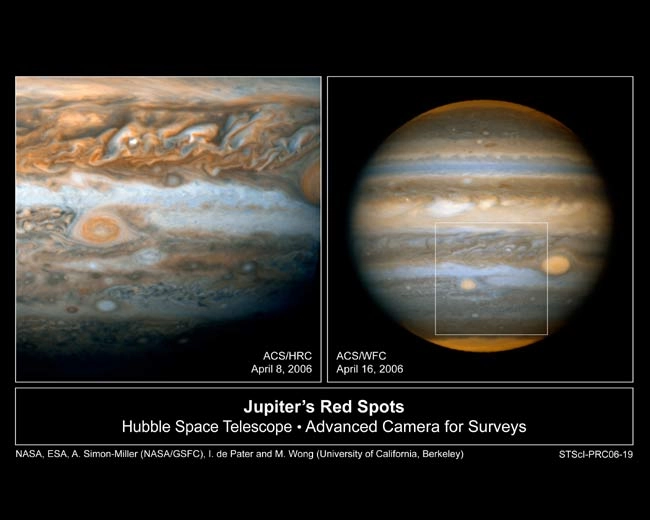
Jupiter's Great Red Spot, shown in a 1999 Hubble telescope image, is almost twice the size of the entire Earth. (Image: Hubble Heritage Team)

On distant Jupiter, the sun's energy is a scant 4 percent of what it is in your backyard. Hardly enough to fuel the incredible storms researchers have been studying from afar. (Consider the Great Red Spot, a hurricane-like oval some 15,400 miles (24,780 kilometers) wide that has been active for 300 years.)

Given that there is so little sunlight, Gierasch and others have reasoned, there must be something else fueling all that stormy weather. That something else is heat from within.


"These systems are two to three times higher [than storms on Earth], andthe wind speeds are a least as large."


Researchers already knew that Jupiter radiates into space almost twice as much heat as it absorbs from the sun. What they didn't know was that this internal heat source could fuel a convective process so remarkably similar to the terrestrial variety.

"These systems are two to three times higher [than storms on Earth], and the wind speeds are a least as large," Gierasch said in a telephone interview. "And they're similar to terrestrial thunderstorm clusters in that there are numerous centers of activity" which spawn intense pockets of lightning.

Why the similarity? Gierasch said the likely answer is simply that the heat, regardless of its origin, comes from below.

A color-coded jovian storm highlights structure. Light areas indicate high haze. Deep red in the lower right shows storm clouds, visible because the haze has cleared. Researchers suspect the clouds result from condensed water driven by convection. The schematic at right is a cross-section of the storm showing the cloud structure. (Image: Peter Gierasch/©Nature)

The big picture

Ruling Jupiter's weather on a larger scale are the wide bands of colorful clouds that circle the gaseous planet, east to west, at speeds up to 300 m.p.h. (480 kilometers per hour).

In another study reported in the same issue of Nature, Andrew Ingersoll and colleagues report that these jets, which are large versions of the terrestrial jet stream, are also fueled by the moist convection described in Gierasch's work.

(The two collaborated on the studies, along with a handful of other researchers, using data collected by the orbiting Galileo spacecraft.)

While the terrestrial jet stream is powered by temperature differences between the equator and the poles, as well as between land and ocean, Jupiter's many jets appear to be energized by the planet's internal heat, Ingersoll explained.

Rising heat fuels rotating eddies, which feed energy into the jets, said Ingersoll, of the California Institute of Technology. Because the energy source is relatively constant, the jets are more stable than those on Earth.

The jets and eddies in turn govern the long-lived giant oval storms, such as the Great Red Spot, the researchers suspect.

Calm amid the storms

While Jupiter may seem to be in a global rage, Ingersoll points out that the jets would appear relatively calm to an observer who dared traverse the planet in a balloon -- assuming that person could survive many other inhospitable aspects of the jovian atmosphere.

"You wouldn't notice that you were moving at 300 m.p.h. unless you were keeping track of other balloons several thousands of kilometer away," Ingersoll said. "But you would have to avoid the violent thunderstorms."

Such a navigational task might not be so difficult. Alvin Seiff, a scientist at the San Jose State University Foundation and Ames Research Center, said the large storms recently studied comprise only 1 percent of the massive planet's surface.

Seiff, who was not involved in the research, said the two studies "represent a notable advance in our knowledge of Jupiter's weather." He added, however, that there is still much to learn: "A remaining uncertainty is what circulation is like below the surface."

Not exactly like Earth

Despite all the similarities, the new research also points out intriguing differences in storms on the two planets. In a terrestrial storm, for example, moisture reaching the surface is like raw material going back into the reservoir. On Jupiter, however, the rain evaporates on the way down. It is immediately put back into the system, rising and condensing, then falling and evaporating, nonstop.

Studying the similarities and differences could improve understanding of atmospheric physics on both planets, researchers said.

And it's possible that we may one day know nearly as much about the weather on other planets as we know about our own. In the modern era, increased understanding of Earth's weather relies heavily on satellite data and computer power, two things that can be applied just as well to other planets.

Therefore, Gierasch said, our knowledge of weather on Jupiter and other planets is likely to grow rapidly if and when more satellites are deployed through the solar system. In fact, he said, the gap in understanding between extraterrestrial and terrestrial weather will likely shrink.

So, are you still afraid to fly?

For now, Gierasch has helped to show that the weather on Jupiter operates similarly to our own, and sometimes knowledge can allay fears. After some time to think about it, he reconsiders the idea of flying through one of Jupiter's massive storms.

"It would be very similar to flying through a terrestrial thunderstorm, except the storm is about twice as big and the winds are probably stronger," Gierasch said. "It might be kind of exciting."


Orion Beginning Stargazer's Toolkit
$32.95
Explore More


Site Map | News | SpaceFlight | Science | Technology | Entertainment | SpaceViews | NightSky | Ad Astra | SETI | Hot Topics
Image Galleries | Videos | Reader Favorites | Image of the Day | Amazing Images | Wallpapers | Games | Community
about us | FREE Email Newsletter | message boards | register at SPACE.com | contact us | advertise | terms of service | privacy statement
DMCA/Copyright
  What is This?