


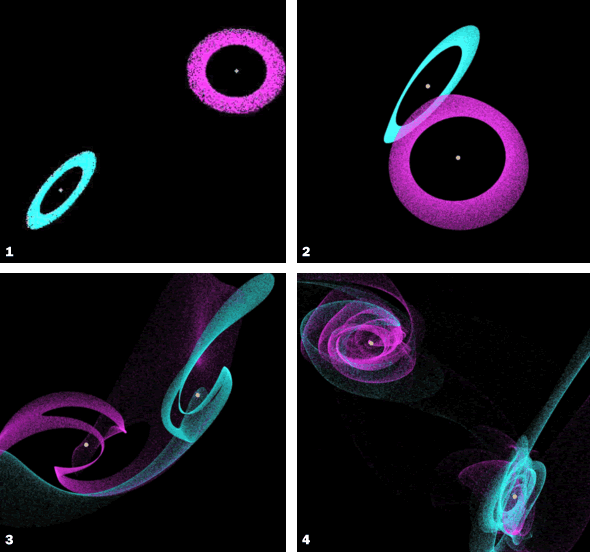
The outer reaches of our solar system may have been shaped long ago by a close encounter with another star that tore up both nascent planetary systems like colliding buzz saws, astronomers said today.
The dramatic encounter, if it occurred, might even have deposited an alien world into our midst.
The scenario was devised to describe unexplained observations of the solar system but is based on speculation about actual events. The resulting computer simulations suggest a range possible outcomes for a close celestial brush shortly after the planets formed, about 4.5 billion years ago.
"It's possible that some of the objects in our solar system actually formed around another star," said Scott Kenyon of the Smithsonian Astrophysical Observatory.
Early chaos
There is no firm evidence that the Sun ever interacted closely with another star, but many astronomers think the Sun was probably born amid a tight huddle of stars, all of which formed out of the same gas cloud. Most stars in the galaxy are known to form in such clusters. The Sun was later ejected from the cluster, the thinking goes.
During that chaotic early time as planets, comets and asteroids were taking shape, its conceivable the Sun passed precariously close to another star, scientists have previously said.
Several studies have employed such an interaction to explain the structure of the solar system or to theorize about how planets develop.
The new computer model shows how young planet-sized objects with circular orbits around the Sun might have been gravitationally slung onto elongated paths, putting them too far away to spot with current technology. Such an interaction might also have caused a sharp cutoff detected at the outer edge of the Kuiper Belt, a region of icy objects beyond Neptune.
The study is reported in the Dec. 2 issue of the journal Nature.
One impetus for the modeling was to explain the presence of Sedna, a world well beyond Pluto that was discovered last year. Sedna is at least half as big as Pluto. It has a highly elongated orbit that is entirely outside the Kuiper Belt. Astronomers don't know how it got on such a course, but they now suspect there may be many similar objects out there awaiting discovery.
Other researchers have said a close stellar flyby might have lured Sedna into its odd orbit.
Kenyon and his colleague, Benjamin Bromley of the University of Utah, put some numbers to the idea. They figure a near-collision occurred when our Sun was at least 30 million years old, and probably no more than 200 million years old. A proximity of between 14 billion and 19 billion miles (22.5-30.5 billion kilometers) could have disrupted the outer Kuiper Belt without altering the paths of the inner planets, they found.
Rock exchange
The passing star's gravity would have swept some space rocks clear out of the outer solar system while simultaneously turning over some frozen rocks and perhaps planet-like objects to the realm of the Sun.
"A close fly-by from another star solves two mysteries at once," Bromley said. "It explains both the orbit of Sedna and the outer edge of the Kuiper Belt."
But there are other ways to get Sedna in its place, says Mike Brown, a Caltech astronomer who led the discovery of Sedna.
"The new study does a great job of exploring one of the possible ways in which Sedna could have gotten on its odd orbit and shows that the method does indeed work, but it is by no means the only possible interpretation," Brown told SPACE.com. "I would say the issue of Sedna's orbit is far from solved."
It is also possible that Sedna was nudged onto its present course by an Earth-sized planet that is no longer in the Kuiper Belt, or by a handful of other means.
"The difficulty, of course, is that with but one single object we can come up with a large number of plausible ways to get it there, but we have no way of proving any one of them," Brown said. "The solution is to go out and find more of these distant objects."
The simulated interaction of the Sun and another star is depicted in images and in an animation.
- Nemesis: Does the Sun Have a 'Companion'?
