




Gravitational waves have revealed a population of black holes that may have been born when masssive stars failed to go supernova.
Most of us know the origin story of black holes, or we thought we did. Massive stars run out of the fuel for nuclear fusion and their cores collapse. As this happens, the stars' outer layers expand outwards. Shockwaves from the core collapse strike the outer layers, triggering a supernova explosion. The collapsed core creates a black hole.
However, new research based on gravitational wave data collected by LIGO (Laser Interferometer Gravitational-Wave Observatory) and its gravitational wave detector partners, Virgo and KAGRA (Kamioka Gravitational Wave Detector), suggests this might not be the complete picture of black hole birth. The team behind the research suggests some massive stars go out with a whimper rather than a bang and that these "failed supernovas" can also spawn black holes.
The hint of this comes from the over 300 black hole collisions spotted by LIGO-Virgo-KAGRA since the detectors first "heard" ripples in space from these distant events in 2015.
"A vast majority of the merging black holes in the universe are about 10 times the mass of our sun," LIGO team member Katerina Chatziioannou, of the California Institute of Technology (Caltech), said in a statement. "Our data are showing that this group of black holes may have a common origin — they may be a distinct subpopulation that failed to go supernova.
"These results represent a connection between the gravitational-wave data and underlying astrophysics we are trying to extract."
Mass and spin of black holes indicate stars died with a whimper not a bang
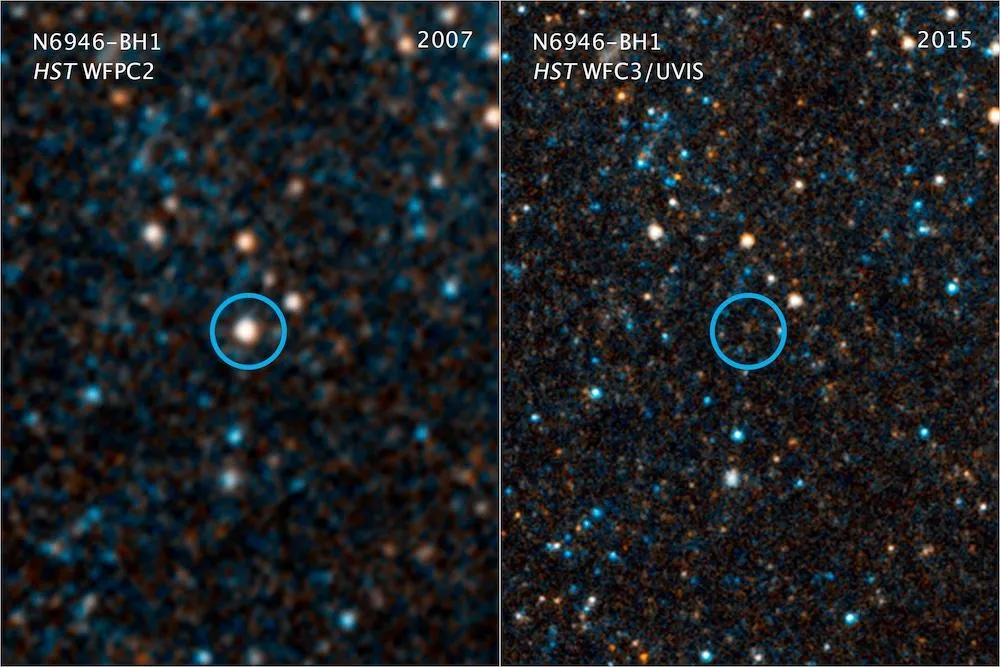
Currently, there is no hard evidence of failed supernovas, but their existence is well supported theoretically. In fact, scientists think there is a vast population of massive stars out there that imploded rather than exploded, directly collapsing into black holes. And these may be black holes with around ten times the mass of the sun (10 solar masses) found in merging pairs.
Chatziioannou led a team that examined gravitational wave data to confirm this concept. To do this, they looked at the distribution of the masses of 257 black hole mergers detected by the LIGO–Virgo–KAGRA network over the past 10 years.
This revealed a peak of 10-solar-mass black holes that represented 75% of the entire sample. If this was expected, what the team found that wasn't predicted was a lack of black holes with masses 12 to 16 times the mass of the sun.
"We see 10 solar-mass black holes merging all the time," team member Isaac Legred of the University of Illinois Urbana-Champaign said. "But why are, say, 14 solar-mass black holes so rare? The gap we see in the distribution of masses indicates there may be a special cocktail of internal physics that goes into forming the abundance of 10 solar-mass black holes."
The researchers also looked at the spin rates of black holes in mergers, a telltale signature of how they formed. This revealed that 10-solar-mass black holes seemed to have a distinct range of spin speeds. This indicates a common origin, perhaps the implosion of a massive star without a supernova explosion.
"We can look up at the sky and try to study historical records of massive stars that failed to explode, but it's challenging because they just vanish without exploding, leaving a dark patch of sky," Legred concluded. "With this study, we show the gravitational-wave data are consistent with most binary black holes forming from a very special kind of failed supernova, but more research is needed.
"Black holes are born in some of the most extreme environments in the universe, so the prospect of better understanding their formation is very exciting."
The team's research was published on Tuesday (Nov. 10) in the journal Physical Review D.