When we think about black holes, we tend to imagine dominant cosmic titans that consume everything around them. However, for many years scientists have mused over the existence of far more diminutive, but short-lived black holes. Using the Large Hadron Collider (LHC), the world's most powerful particle accelerator, scientists have been on the hunt for quantum black holes that are smaller than atoms. This is a tricky proposition, as these black holes would have a lifetime as diminutive as their size.
The discovery of such objects could help solve some of the mysteries surrounding the structure of space and time, united as a four-dimensional entity called "spacetime."
It could also help researchers develop a theory of quantum gravity that unites the thus far incompatible theories of general relativity, our best description of gravity, and quantum physics, the framework that describes the universe on scales smaller than atoms.
"Had we found evidence, we could have begun to directly study quantum gravity," Tamas Vami, a researcher at the LHC experiment Compact Muon Solenoid (CMS), said in a statement. "It's a step toward unifying all of the known fundamental forces, which has been a goal of physicists for more than a century."
Unfortunately, this search has thus far been fruitless, but that doesn't mean that it has been useless. Null results in this case redefine the search parameters for these tiny black holes and help perfect methods that can be used to hunt for new particles beyond the Standard Model of particle physics.
"It's not a dead-end," Incandela Lab researcher Danyi Zhang explained. "The result is an exclusion limit, which is a real, publishable statement: 'If this thing existed with these properties, we'd have seen it. We didn't, so we can rule it out here.'
"That's genuine knowledge about how the universe works."
The hunt for a new paradigm
The answers to the universe's most tantalizing mysteries are theorized to lie in physics beyond the Standard Model. New physics may only manifest at high-energy levels, the sort of energies that the LHC generates by slamming together protons at near light speed.
Thus far, this new physics has failed to manifest at the LHC, but this only makes scientists more keen to hunt for what could represent a paradigm shift on a scale comparable to the development of Einstein's theory of general relativity.
Scientists also think that quantum black holes could emerge from the trillions of proton collisions occurring in the LHC. That has often been misinterpreted as the potential for the LHC to create a potential Armageddon-inducing stable black hole, but the truth is that if the world's most powerful particle accelerator did create a black hole, it would evaporate instantly, certainly too rapidly to gobble up Earth.
A classic astrophysical black hole forms when a massive star collapses under the influence of its own gravity, causing its core to crunch down to an infinitesimally small point. To make a quantum black hole, on the other hand, energy would have to be compressed to a tiny volume.
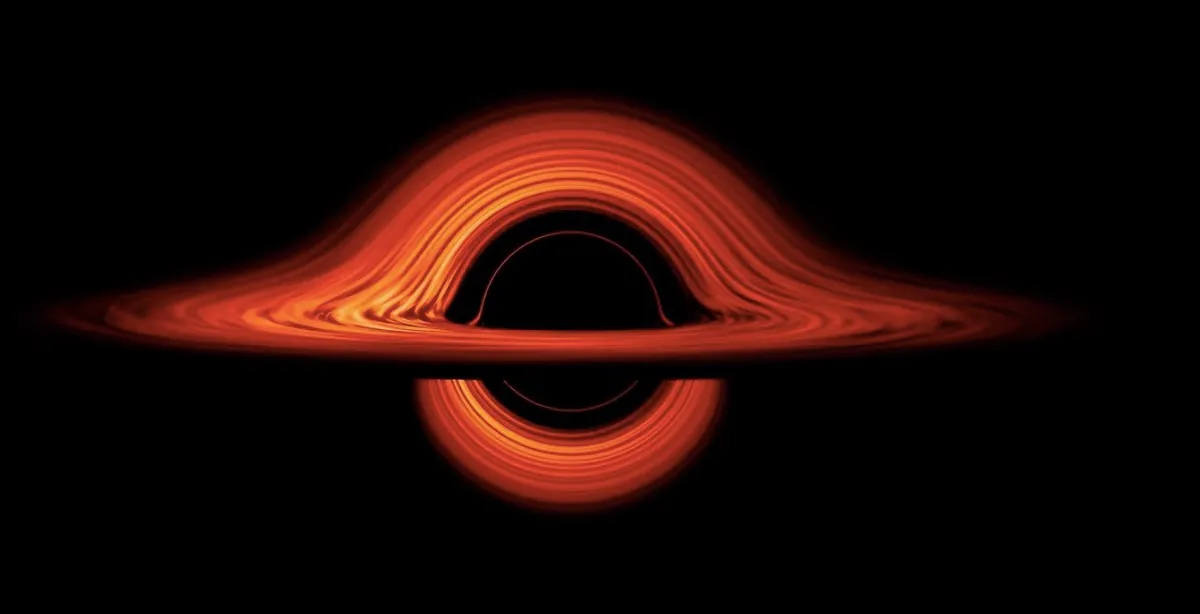
One theory suggests that this compression could occur in extra "hidden" dimensions of the type required by string theory and other extensions to standard physics that offer a grand unified theory. These hidden dimensions could also explain why gravity is the weakest of the universe's four fundamental forces, something that has puzzled scientists for decades. If this proposal is correct, gravity would "leak" into these extra dimensions in which it becomes substantially stronger.
The extremely high energy generated at the LHC corresponds to distances so small that they are to an atom what an atom is to our bodies. The perfect scale to hunt for quantum black holes.
How do you detect a disppearing black hole
If a black hole disappears instantly, detecting it directly would be impossible even for sophisticated detectors at the LHC. An easier route is to detect such an object via the particles and energy released when it decays.
The decay of a quantum black hole would leave a very unique signature in terms of its shape and energy.
"You form a black hole, and it immediately disintegrates. But it has a very spherical decay signature, lots of things going in all directions," Zhang said. "We know that black holes are very high energy. So we basically just take the energy of these particles that are decay products of whatever was created in the collision and sum them together. And if the sum is large enough, we can say that this is the region where we are likely to find the signal."
Zhang and colleagues used a new technique to scour data collected by the CMS detector up to energies of 12 Tera-electron volts (TeV). They failed to find evidence of quantum black holes or hidden dimensions, but they aren't disheartened.
"Theories don’t predict one exact answer; they predict a whole range of places a particle could be hiding," Zhang said. "Each search clears out part of that range and says 'not here,' and over time the map of where new physics could still be shrinks."
That's a proven technique, especially for LHC research. That process of elimination led to the discovery of the Higgs boson back in 2012. And the search for quantum black holes is definitely worthwhile. It could soothe a headache that has bothered physicists since the development of general relativity and quantum physics during the early years of the 20th century.

As more data is collected and higher-energy domains are explored, the probability of finding a quantum black hole via its products increases. And that would put researchers tantalizingly close to the unification of quantum physics and general relativity.
"We have two big theories that describe nature. If you want to describe things that are small, you go to quantum field theory. We have the Standard Model to describe all the particles, and it performs exceptionally well in practice. And when you go to the very, very big, you have general relativity that would describe how big and massive objects behave," Vami said, also explaining the difficulty in merging these theories emerges from the fact that the conditions at which they overlap would be rarefied..
"That's really hard to do because you don't often have a situation which is really tiny but also extremely heavy."
Quantum effects come into play at the edge of astrophysical black holes, but these effects are even more significant for the tiny black holes that would be created at the LHC.
For that reason, the hunt for quantum black holes is set to continue until research like this leaves these curious objects nowhere left to hide.
The team's research was published in the journal Progress in High Energy Physics.