





China's space station is set to receive its first foreign astronaut.
A Long March 2F rocket, topped with the Shenzhou-24 crew spacecraft, was rolled out to the pad at Jiuquan Satellite Launch Center in northwest China, on Tuesday (Nov. 17), with launch expected in the next week.
The 191-foot-tall (58 meters) rocket was transferred 0.93 miles (1.5 kilometers) from a vertical integration building to the pad over the course of around two hours, starting around 4 a.m. EST (0900 GMT, or 5 p.m. Beijing Time), according to China Central Television (CCTV).
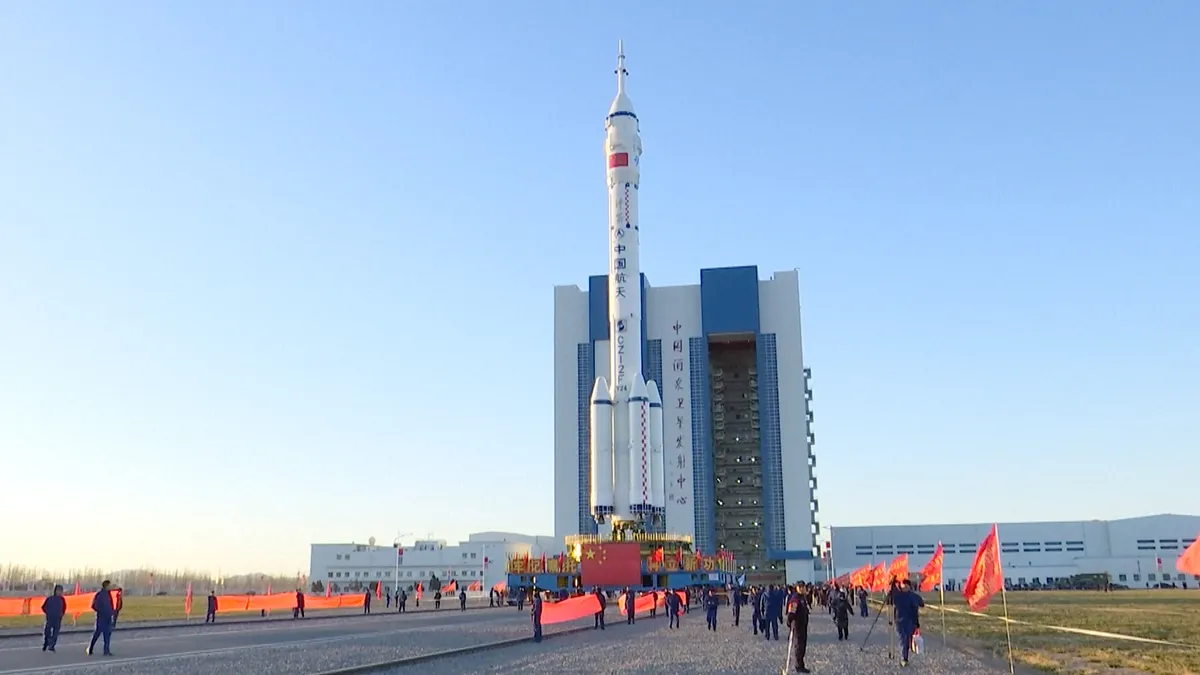
China's human spaceflight agency, CMSA, stated that all facilities and equipment at the launch site are in good condition, adding that the launch is scheduled to take place in the coming days, without providing a date.
CMSA typically holds a press conference at Jiuquan a day ahead of launch, during which the crew for the mission is revealed to the public. This time, one of the three crew members will, for the first time, be an international astronaut. One of two Pakistani astronaut candidates will fly to the Tiangong space station on Shenzhou-24, marking a first both for China's outpost and for Pakistan, which will see one its astronauts reach orbit for the first time.
Though public details are sparse, it is thought that the Pakistani astronaut, operating as a payload specialist, will stay aboard Tiangong for around a week, returning home on the departing Shenzhou-23 spacecraft.
One of the three Shenzhou-23 astronauts — who are approaching the end of their six-month-long mission, having launched on May 24 — will stay aboard Tiangong for another half a year. This will provide the international visitor with a seat home on Shenzhou-23, and allow a Chinese astronaut to make the country's first year-long stay in orbit. This extra-long mission will supply China with data on physiology ahead of crewed lunar flights and other long-duration missions.
China approved its human spaceflight program in 1992 and launched its first orbital crewed mission in 2003, with Yang Liwei becoming the first Chinese national in space. The country then completed the three-module Tiangong space station in late 2022 and has kept the orbital outpost constantly crewed ever since, with rotating six-month-long missions with brief handovers between crews.
Shenzhou-24 will be China's 18th crewed mission and will mark the first time a foreign national is flying on a Shenzhou spacecraft. China is also looking to double the size of Tiangong in the coming years, potentially opening the way to further international missions and space tourist visits.