Japan's H3 rocket flew for the ninth time ever this afternoon (Aug. 10).
The H3 lifted off from Tanegashima Space Center today at 3:23 p.m. EDT (1923 GMT; 4:23 a.m. on Aug. 11 local time), carrying the Michibiki 7 navigation satellite aloft.
The H3's upper stage deployed Michibiki 7 into its target orbit 29 minutes later, eliciting cheers from the folks in mission control.
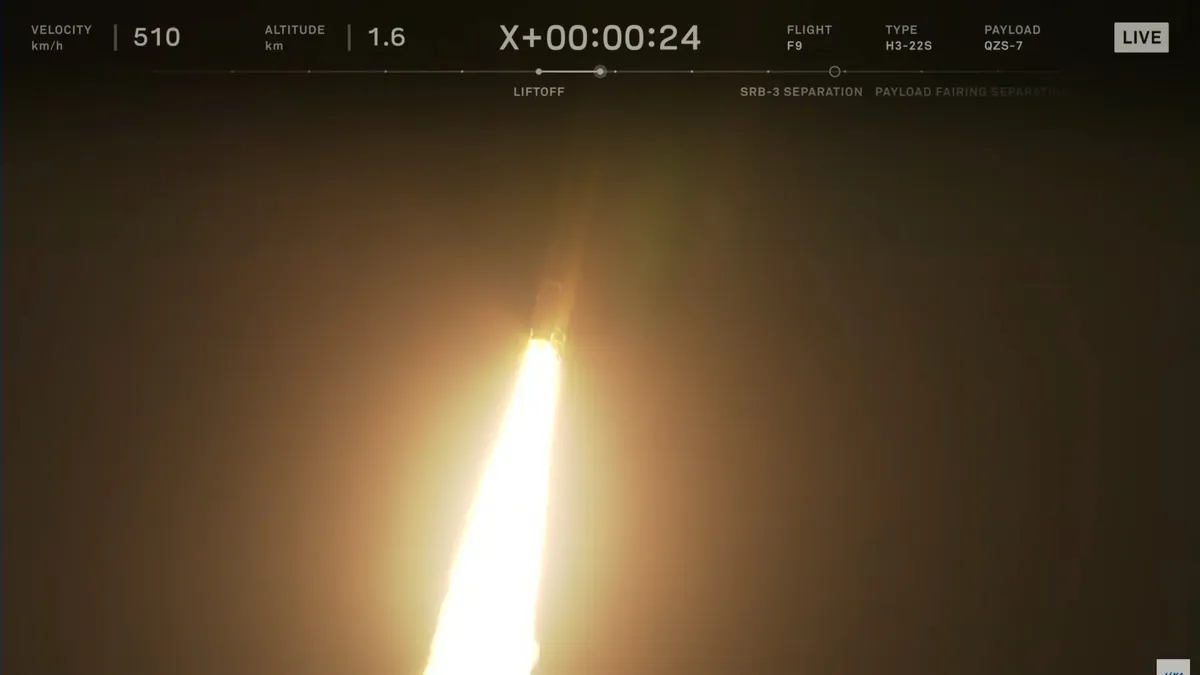
The two-stage H3 is the successor to Japan's workhorse H-2A rocket, which retired last year after a total of 50 flights.
The H3 — which stands 187 feet or 207 feet (57 or 63 meters) tall, depending on what type of payload fairing it employs — debuted in March 2023 and had eight liftoffs under its belt before today.
Two of those eight were failures — the debut flight and the launch of Michibiki 5 in December of last year. But the H3 bounced back from that latter anomaly two months ago, successfully delivering six satellites to orbit on June 11.
Michibiki 7 will be part of Japan's Quasi-Zenith Satellite System (QZSS), a homegrown navigation system that operates high above Earth in geosynchronous orbit.
"This system is compatible with GPS satellites and can be utilized with them in an integrated fashion," Japanese officials wrote in a description of the QZSS project. "QZSS can be used even in the Asia-Oceania regions with longitudes close to Japan, so its usage will be expanded to other countries in these regions as well."
The QZSS network will eventually consist of 11 satellites, if all goes according to plan. There are five such spacecraft operating in orbit at the moment.
Michibiki 7 is carrying a payload for the United States as well — the Situational Awareness Camera Hosted Instrument (SÃCHI), which was developed for the U.S. Space Force by the MIT Lincoln Laboratory. This is the second of two SACHIs to go up on a QZSS satellite; Michibiki 6, which launched atop an H3 in February 2025, hosts the other one. (Yes, Michibiki 6 launched before Michibiki 5.)
"This program will allow the United States to monitor satellite behavior within the GEO belt over a very interesting part of the world," Mark Huber, a technical staff member in the Lincoln Laboratory's Space Systems and Technology Division, said in a statement in December 2020.
"It is also a pathfinder in several ways," he added. "The U.S. team is blueprinting methods to allow sensitive data sharing between the United States and Japan."
Editor's note: This story was updated at 3:55 p.m. ET on Aug. 10 with news of successful launch and satellite deployment.