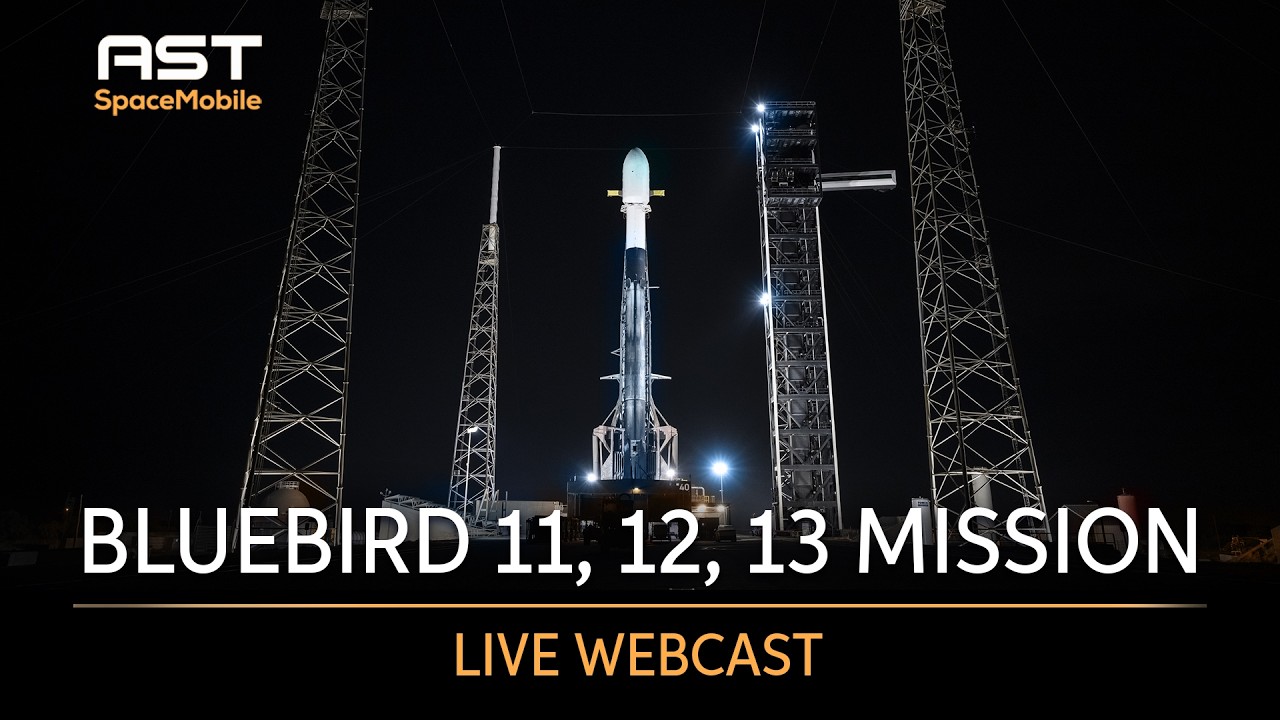
A SpaceX Falcon 9 rocket carrying three of AST SpaceMobile's massive direct-to-cell BlueBird satellites launched from Florida's Cape Canaveral Space Force Station at 3:50 a.m. EDT (0650 GMT) on Wednesday, minutes after the opening of its 96-minute window.
Today's launch further expands AST SpaceMobile's constellation in low Earth orbit (LEO), which will beam internet service directly to unmodified smartphones once operational.
The newcomers bring the total number of BlueBird spacecraft launched to 13 and marks a significant milestone toward getting the constellation fully up and running, according to AST SpaceMobile.

"This orbital launch, combined with expanded manufacturing capacity and the recent successful launch and deployment of BlueBird satellites 8, 9, and 10, position us for beta services later this year with our space-based cellular broadband coverage," Scott Wisniewski, the company's president, said in a July 28 statement.
AST SpaceMobile began assembling its constellation with "Block 1" spacecraft, which have communications arrays that cover 693 square feet (64.4 square meters) when unfurled.
That's pretty big, but the company upped the ante with BlueBird 6, which reached LEO atop an Indian LVM3 rocket in December 2025. That was the first "next-generation" BlueBird, a class whose antennas cover a whopping 2,400 square feet (223 square m).
Prior to today's launch, there had been four next-gen BlueBirds in LEO — numbers 6, 8, 9 and 10. (BlueBird 7 was lost shortly after liftoff this past April after its Blue Origin New Glenn rocket suffered an anomaly.) So, BlueBirds 11 through 13 will nearly double the off-Earth population.
"These next-generation BlueBird satellites are expected to deliver nearly double the peak download speeds achieved by the company's initial Block 1 BlueBird satellites, which recently demonstrated peak download speeds of 98.9 Mbps directly to standard smartphones," AST SpaceMobile wrote in the same statement.

The Falcon 9's first stage returned to Earth roughly 8.5 minutes after launch, touching down in the Atlantic Ocean on the SpaceX drone ship "A Shortfall of Gravitas."
It was the 30th launch and landing for this particular booster, according to a SpaceX mission description. The rocket also flew the BlueBird 8-10 mission in June.
The Falcon 9's upper stage, meanwhile, went on to deploy the three BlueBird satellites into LEO over an 11-minute span beginning 53.5 minutes after liftoff.