




On Oct. 25, 1671, the Italian astronomer Giovanni Cassini discovered a new moon at Saturn! Iapetus was the second moon anyone had ever found orbiting Saturn, and it was the first of four moons Cassini would discover at the ringed planet.
The Dutch astronomer Christiaan Huygens had discovered Titan, the largest of Saturn's moons, about six years earlier. After Cassini found Iapetus, he also found the moons Rhea, Tethys and Dione.
When Cassini first saw Iapetus, the moon looked like a tiny speck on the west side of Saturn. He calculated its orbit and thought he would be able to see it again on the east side of Saturn 39 days later, but it was nowhere to be seen. When it reappeared on the west side again, Cassini realized that Iapetus must be darker on one side than the other, which made it harder to see when the dark side was facing Earth.
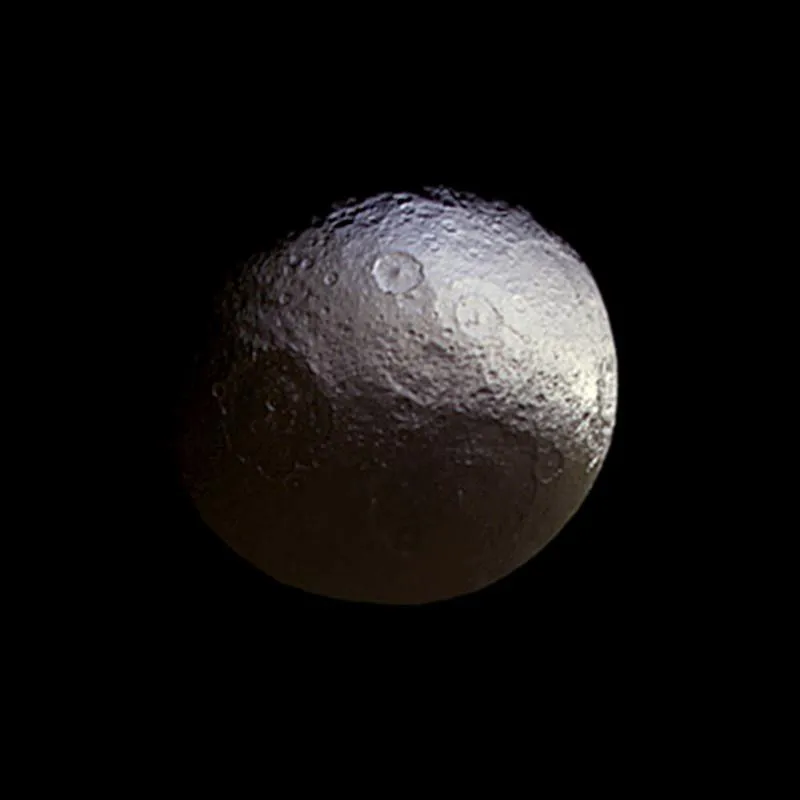
More than 300 years later, NASA sent a spacecraft named Cassini to Saturn, and that Cassini took some pretty awesome photos of Iapetus. Realizing Iapetus kind of resembled a yin-yang, it has since been nicknamed the "yin-yang moon."
How it mattered
The discovery of Iapetus, with its yin-yang bright and dark hemispheres, has added to our understanding of how moons form.
"Using the computer simulations, the researchers concluded ... the inner moons of Saturn and its gorgeous rings are all relatively young. The more distant moons Titan and Iapetus would not have been formed at the same time."
"Our best guess is that Saturn had a similar collection of moons before, but their orbits were disturbed by a special kind of orbital resonance involving Saturn's motion around the sun. Eventually, the orbits of neighboring moons crossed, and these objects collided. From this rubble, the present set of moons and rings formed."
Want more space history? Check out our full On This Day In Space Story archive and watch our On This Day In Space videos on YouTube.