




This is a great month for planet watching, either in the evenings or mornings. During convenient evening hours, the planet of choice is Saturn, visible well up in the southern sky during mid-to-late evening hours. Telescopically, the southern side of its famous ring system is currently tilted about 6½ degrees to our line of sight.
Around the middle of the night, Mars and Jupiter come into view above the east-northeast horizon and just before the break of dawn are in excellent position, soaring high in the southern sky in the vicinity of the Sickle of Leo the Lion. Watch how Mars approaches Jupiter early in the month, passes it on Nov. 16, then spends the rest of the month sailing away to the east.
Meanwhile, in the predawn morning sky, Venus literally vaults into prominence as the month progresses. And from midmonth on through the end of November, Mercury asserts itself, appearing as a very bright "star" to the far lower left of Venus.
In our schedule, remember that when measuring the angular separation between two celestial objects, your clenched fist held at arm's length measures roughly 10 degrees. Here, we present a schedule below which provides some of the best planet viewing times as well directing you as to where to look to see them
Reminder: On Nov. 1 — where applicable — change clocks back one hour from Daylight Saving Time. On this date, the clock hour from 1 to 2:00 a.m. is repeated, thus making this day the longest of the year: 25 hours long. The mnemonic is: "Spring Ahead, Fall Back."
Mercury
Mercury, hidden during inferior conjunction with the sun on Nov. 4, will emerge in the eastern morning sky after the second week of the month to undergo an excellent morning apparition for the Northern Hemisphere. This rocky little world arrives at its greatest western elongation (20 degrees) from the sun on Nov. 20; its most favorable morning apparition of the year for mid-northern observers. From Nov. 16 to Nov. 26 speedy Mercury will rise in the east-southeast before the beginning of astronomical twilight, more than 95 minutes before sunrise.
Venus
Venus is a good reason to be up at the crack of dawn in November; it's a silvery lamp that rises above the east-southeast horizon. Venus was at inferior conjunction on Oct. 24. But the steep angle of the ecliptic at dawn in late autumn helps Venus vault noticeably higher with each passing day for observers at mid-northern latitudes. On Nov. 1, it rises 55 minutes before the sun. But just several days later on Nov. 5, viewers around 40 degrees north latitude can see Venus come up one hour and 25 minutes before the sun and shine 15 degrees above the horizon at sunrise. As November ends, Venus rises nearly 3½ hours before the sun and hangs nearly 35 degrees up at sunrise.
All month Venus brightens impressively and on the penultimate day of the month it will reach the pinnacle of its magnificent brightness, shining at magnitude -4.9, rising almost 3½ hours before the sun. If there's snow on the ground, check for shadows made by Venus's light. Through a telescope, the phase of the planet looks most remarkable early in the month. That's when you may be able to glimpse Venus when it's only a few percent illuminated, a hairline crescent close to an arcminute long; about 1/30 the apparent diameter of the moon. Venus is not alone in the dawn sky.
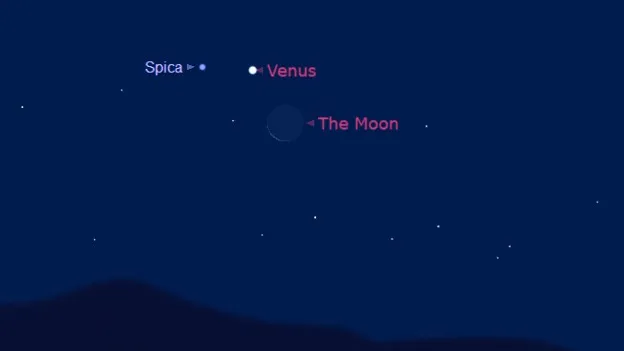
Its leap takes it up into the proximity of the bluish 1st-magnitude star Spica in Virgo on the morning of Nov. 3. The star will be sitting 2.4 degrees to the upper right of Venus. During this month, Venus seems to perform a dos-à-dos with Spica and at first seems destined to soar up and catch it. Instead, the closest it gets to this star is 1.8 degrees to its upper left early on the morning of Nov. 19.
On the morning of Nov. 7, a striking array of a waning crescent moon, brilliant Venus and Spica awaits early risers low in the east-southeast sky about an hour before sunrise. The trio will be bunched together inside of a circle measuring only about 2½ degrees in diameter.
Mars
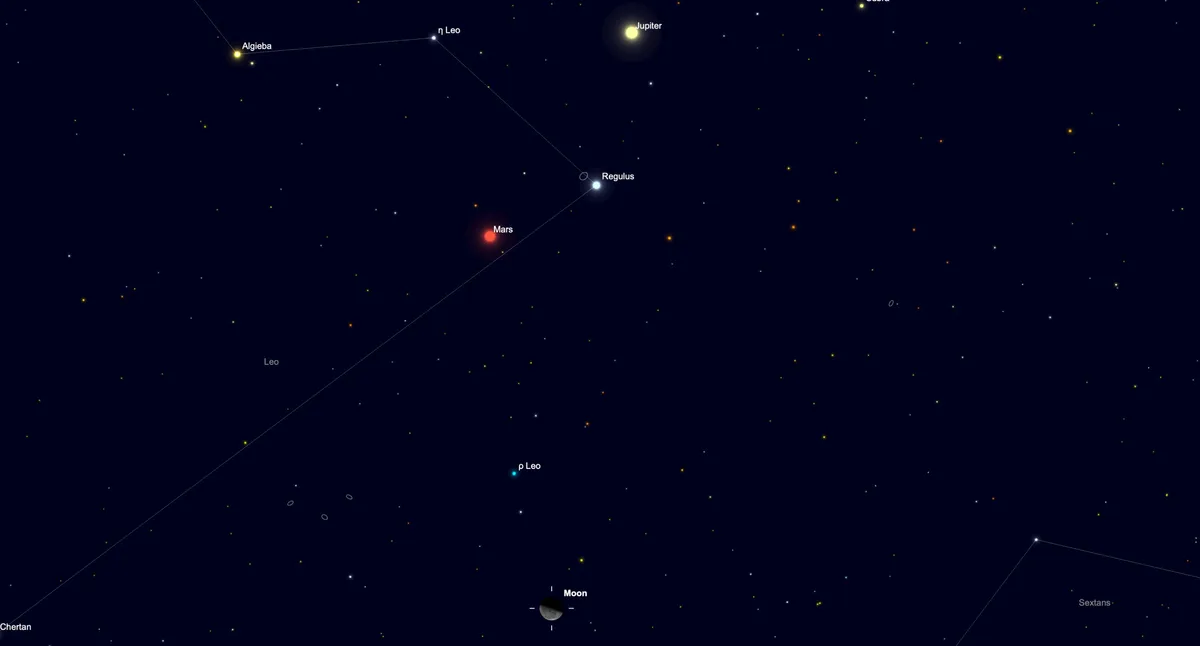
Mars, shining at magnitude +0.9, is in Leo in the morning sky and is easily found on the morning of Nov. 2, using the moon as a guide. That day it sits a couple of degrees to the left of the moon. In addition, on that date, Mars is positioned 5 degrees to the upper right of much brighter Jupiter.
Mars has been hiding in the glare of the sun, or in the dead of the early morning hours, for the last year and a quarter. Now it finally rises in the east before midnight. Each night, watch the orange-yellow planet move a little closer to Jupiter. They'll be in conjunction on Nov. 16 (See Jupiter below).
On the morning of Nov. 26, Mars, having brightened to magnitude +0.6, passes 1.7 degrees to the upper left of the first magnitude star Regulus in Leo. The color contrast between the orange-yellow planet and blue-white star is striking, especially in binoculars.
Jupiter
Jupiter is high enough for a steady telescopic view by 3 a.m. But its dusky cloud belts and Red Spot can be seen more clearly when the planet is highest in the southeast soon after dawn breaks.
On Nov. 3, shortly after 1 a.m. local time, look low toward the east-northeast horizon to watch the moon slowly ascend the sky. The 1st magnitude star Regulus will be evident sitting a degree to the moon's left. And sitting about 5 degrees above the moon will be Jupiter, appearing as a brilliant "star" shining with a steady, silvery light.
Mars passes 1.2 degrees to the upper left of Jupiter on Nov. 16; the giant planet outshining the red planet 13-fold. Late on Nov. 29 and into the early hours of Nov. 30, look low toward the east-northeast horizon for a gathering of the waning gibbous moon, with Jupiter, Regulus and Mars. These four celestial bodies cover an expanse of roughly 7 degrees going from right to left. Best views will come around the time of the break of dawn when they'll appear to soar high in the southern sky.
Saturn
Saturn is situated in the northeast corner of the non-zodiacal constellation of Cetus the Whale (or Sea Monster). It crosses the southern meridian around 9:45 p.m. at the beginning of November and about two hours earlier at the month's end. All evening, it is excellently placed for telescopic viewing of its glorious ball and rings. At magnitude +0.6, Saturn is easily the brightest point of light in its section of the heavens. It can also be told from the stars by its steady, yellowish light.
On the evening of Nov. 18, take note of Saturn mimicking a bright "star" shining about 6 degrees below the waxing gibbous moon.
Joe Rao serves as an instructor and guest lecturer at New York's Hayden Planetarium. He writes about astronomy for Natural History magazine, Sky and Telescope, The Old Farmer's Almanac and other publications.